Wednesday, January 29, 2014

Time savers for the busy teacher!

Let's face it- there simply is not enough time in the day of a typical teacher.  Inspired by Sarah's post at Math = Love,  I decided to write my own tips for saving time.  Most of these tips save time for me and for my students. 

My biggest time-saver is my materials tubs.  They're large shower caddies from Walmart that I loaded up with everything my kids ever need to use.  Each group of 4 has a tub that is stored on a shelf in my classroom.  I don't have 28 children traipsing across the room to get scissors or colored pencils or dry erase markers every time we use them nor do I have to pass them out and collect them myself.  Just 7 kids need to move to get a tub with everything their group could need.  I have almost no problem at all with things being left out on desks between classes, though sometimes materials get misplaced in the wrong tub and have to be redistributed.  (This happens when an eager child replaces his group's tub before his group mate has put away her scissors.  When she goes to return them, she places hers in the wrong tub).  You can see my post here where I describe them in depth.


Another favorite time saver is like Sarah's first tip.  I bought some plastic drawers like these: http://www.sterilite.com/SelectProduct.html?id=329&ProductCategory=186&section=1.  In one, I keep three kinds of frequently-used graph paper.  In the other, I keep notebook paper and copy paper.  I don't have to remember where I filed my graph paper or copy it each time I'm going to use it.  I simply copy several hundred sheets at a time and reload the drawers when they get low.  My students know where the papers are stored and can help themselves.  This is especially nice when a student decides he wants graph paper and I'm helping another student clear across the classroom- there's no need for interruption.  I have another bank of these drawers in which I store my colored copy paper.  That helps me see which colors I can choose from and which I might need to restock.

I just graded several Interactive Notebooks last night and I was reminded how easy it was to do so thanks to the rubrics I have glued into the notebook.   Having them glued in means I don't have to copy more papers, write students' names on the rubrics, or separately pass them back to students and have the students store them.  I just open the notebook, circle the points earned, record the score, and close the notebook.  How simple!  The best part is that the rubrics are there all year so the students can look back and see how they've been doing throughout the year.  I can also follow up to see that improvements were made following the most recent notebook check without digging through records. 

Missing work can be another huge time-suck. Don't forget the dreaded student question, "I was absent yesterday.  Did I miss anything?"  These organizers have made my life so much easier than before!  You could use any kind of organizer to accomplish this; I've seen file folders and letter trays also be used effectively.  I've combined this set of organizers with a "While You Were Out" slip that can quickly communicate to a student what was missed.  I haven't gotten students to fill them out as I originally planned; I find I can usually fill these out in a minute or less while students are working on something independently.  I keep a basket of them along with a box of paper clips just next to the hanging organizers.
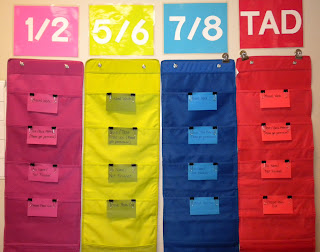

Warm-up folders (I'll get to talk more about this at TMC2014!!!) are a small time saver, but an important one.  In my school, we give individual grades on warm-ups every day.  To quickly pass out and collect warm-ups, each student is assigned to one of about 5 file folders for that class period.  The warm up papers are stored there so the child can pick up his paper from the folder at the beginning of the class and return it there when it is complete.  This is much faster than each child shuffling through a stack of 28 papers or having someone pass them out at the start of class.  I go through each folder and grade the papers every afternoon.

Gosh, there are probably more great time savers I could share but I'm off to be productive around the house on this snow day.

How do you save time in your classroom?

Mathematically yours,
Miss B

P.S.- If you haven't gone to read Sarah's post at Math = Love yet, please do since she inspired this post! 

Tuesday, January 28, 2014

January Recap

It's hard to believe that we're already nearly at the end of January.  This has been a short teaching month.  We returned from Christmas break on the 6th.  By the middle of the month, we were dealing with delays due to ice or fog.  The first term ended on the 17th and we were out of school all of last week due to the MLK holiday, teacher inservice (from which we were excused to leave early) and three snow days.  Yesterday, we had a delay because the roads were still a mess and it looks like we might have another bit of snow tonight that threatens to interrupt tomorrow.  All of these interruptions have been a bit of a nuisance.  I want to get back into routine and it's just not happening! 

Good news: I'm definitely going to Twitter Math Camp 2014.  Now, I just have to get my travel plans in order.  I'm so excited to meet face-to-face with virtual friends! 

Other good news: A student who has been giving me trouble lately with behavior and work ethic voluntarily came for extra help today and we had a good discussion.  I'm curious to see if things change for the better in the coming days. 

Good news part three: I'm making good progress on my NBCT portfolio. 

Monday, December 16, 2013

Why My Kids are the Best

Today was a Monday. Last week was a crazy week, complete with a "snow" day for rain, a delayed opening for ice, a teacher inservice day, and a Career Day program. That made for an entire week with only one "normal" day, Thursday. When I walked into school today, I could see that my co-workers were dragging. No one, it seemed, wanted to be back in school this week after last week's taste of freedom. I suspected my kids would feel the same way. Thank goodness I underestimated them.

My first period class is learning how to solve equations. We're working on equations with variables on both sides. I was immensely proud of how all 20 of my kids were doing beautiful work and checks this morning. I only had to remind two kids to check their work. The students who were getting stuck were actively asking for help. This must be some sort of pre-Christmas miracle! At the end of the class, one girl spontaneously shared, "This is the first time I've ever liked math. Before, I hated it and now it's my favorite subject. My dad can't believe it because I always used to say how much I hated math." That darling earned a high five and I told her she'd just made my week!

I also really like how I had my kids do their equations today.

You know, because sometimes you just want to use a canned worksheet but you loathe their spacing and don't really see any practical reason to retype the problems.  (Does that make me a "bad" teacher?  Perhaps to some who literally make every paper their kids touch.  I look at it more as "picking my battles."  And, I've learned that I'm not very good at writing equations with a good variety of all the things kids need.  Inevitably, I leave off fractional coefficients, or negative coefficients, or negative answers, or... you get the idea.)  So, I announced to my class that I can't stand when I ask kids to write on notebook paper instead of a worksheet and someone decides to try to cram all of their work onto the worksheet, necessitating skipping steps and writing illegibly to make it work.  We wouldn't be doing that.  Instead, we put glue on the bottom and two sides of the worksheet and attached it to the bottom of our notebook page.  That left the top edge open as a pocket.  Then, we worked the problems (and checks) on notebook paper which we could fold and store in the pocket.  Happy teacher, happy kids!  This should keep lost papers to a minimum and ensures everyone is showing work.  By the way, that worksheet is ancient.  I couldn't even tell you with certainty what book it's from though I would guess Holt; my coworker ran them off for us both. 


Fast forward to my afternoon class and the kids are doing some classwork on exponential functions; nothing too inspired, really. I reminded them that page 35 in their ISN would be useful in completing the classwork. As I circulated around, I stopped and asked students how the work was going. One pair met me with a chorus of "It's hard; it's confusing!" These girls are very capable but they are so scared to make a mistake that they get in their own way. We had a conversation around the idea that they're going to have to do some things that are challenging if they want to continue to learn. That means they're going to have to get some things wrong here and there. Each time they get something wrong and struggle with it a little, they're learning. "You and I, we've been told from a young age that we're smart by our parents and teachers who love us very much. Unfortunately, that's set us up. Now, we think that we won't be able to be considered smart if we get something wrong." (The girls nod.) "That's really unfair. We need to think of ourselves as hard working and be proud of ourselves for giving full effort. We can work hard no matter how easy or difficult the challenge in front of us is, so it's something we can control." The girls agreed and they got to work on the problem that they had just a minute earlier said was, "confusing." A few minutes later when I came by again, one of them was proud to show me her correct answer. She said, "These notes are really useful. I saw the connection between the question and what we had written here and here on the notes," gesturing to different parts of a foldable we'd completed earlier in the unit. Award one point to Jo Boaler's "How to Learn Math" and one point to ISNs!

Why are your kids awesome?

 Mathematically yours,
Miss B

Thursday, December 12, 2013

Today, in 7th Period...

For the past several weeks, my 7th period class has been increasingly frustrating to me.  The students are supposed to enter the room, get their warm-up papers, and work on the five daily problems independently while I take attendance, check homework, and give some assistance to those who are struggling.  This takes about 10 minutes on most days.  Recently, though, the students are being less and less independent.  They're trying to ask each other for help, comparing answers, and some are blatantly copying from others. On this type of task, I consider those behaviors to be cheating.  I thought most of this problem stemmed from the opportunity they had to influence our most recent seating chart.  So, they got new seats on Monday.  Today, the same problems were happening.  I stopped the kids and launched into a heartfelt lecture. 

"Raise your hand if you understand what I mean by 'independent work.'  Good.  Everyone knows that concept.  Who can describe it for us?" I started. 

"When you do your own work without your classmates' help," someone offered. 

"Exactly.  So that means that during this time, you shouldn't be talking to other students.  You also shouldn't be looking at their papers.  You shouldn't be comparing answers.  All of those things are forms of cheating.  I would like you all to have integrity.  Do you know what that is?"

"Doing the right thing when no one is looking," said one student.

"Being honest," another suggested.

"For sure.  I want to be proud of all of you because you show integrity.  That's much more important to me than your score.  Now, I know some of you are worried about your grades.  Some of you might be feeling pressure from home."

At this point, there are lots of small, quiet nods.  This is, after all, an advanced group.  These are the parents who will send e-mails the second their child gets an 89 instead of an A. 

"Look, I want you to keep your integrity.  I would much rather you earn a slightly lower grade honestly than get a higher score because you cheated.  I think your parents would agree.  If you're not sure, ask them at dinner tonight.  I want to be proud of you and for that you need integrity."

After this, they got back to work, and I had a kid who got a near perfect paper yesterday ask for help.  "But you did so well yesterday, what's wrong today?" I asked.  "I got help yesterday," she admitted.  I answered, "Thanks for being honest about that today.  Now let's see where you're getting stuck."

My next step is to develop a class honor code.  These kids are largely college bound.  I want them to see how important it is to be truthful and work hard.  If they don't learn that lesson now, I'm afraid they might learn it at a time it costs them a semester's tuition or more. 

Here's the questionnaire I'm going to use to get the conversation started.


How do you teach your students to have academic integrity?

Mathematically yours,
Miss B

Tuesday, December 10, 2013

Snow Day #1...

...or should I say, "Rain Day #1?"  It may have snowed for an hour or two this afternoon, but nothing accumulated.  We actually got more on Sunday despite the fact that we were predicted to get 2-4" today.  I used my day pretty wisely and managed to go grocery shopping, make a roast in the slow-cooker, put up and decorate my Christmas tree, and catch up with my great aunt on the phone.  It was lovely.

Tomorrow is scheduled as an inservice day.   Friday is "career day."  That means my teaching week is comprised of a 2 hour delay on Monday and a full day on Thursday.  Anyone want to take bets on how motivated to work my kids will be on Thursday? I'll be sure to do some extra active things on Thursday to keep things going smoothly. 

Mathematically yours,
Miss B


Monday, December 9, 2013

Derailing for the Sake of My Students

We've been working on equations slowly since sometime in September in my Math 8 class.  To be successful with equations, we took a detour through integers.  Now, we need to refresh our rules for fractions and decimals as well so we have the whole arsenal of rationals at our disposal since most kids are currently screeching to a halt if they see anything that's not an integer.  My initial plan was to give the kids foldables, fill in the examples, and move on. 

Last night, however, I read Tina Cardone's Nix the Tricks cover-to-cover.  Stop now, go download the FREE book, and read it now or file it for reading before January 1.  It's important.  Essentially, it's a compilation of things that teachers sometimes teach with a procedure instead of conceptual understanding and suggestions for teaching the concept from the get-go.  The thing that teachers, students, and parents need to realize is that once you build good conceptual understanding, you don't have to worry about learning a particular procedure because they steps will naturally make a lot of sense. 

With this reading freshly in my mind, I couldn't handle it when my students couldn't explain why they convert a mixed number to an improper fraction by multiplying the whole by the denominator, adding that to the numerator, and putting the sum over the denominator.  We stopped.  We modeled three and one-third.  We showed how the whole number 3 represented 9 thirds and that together with the other one-third, we had ten-thirds. 

Then next thing students wanted to do was get a common denominator.  They couldn't explain why 12 would be an appropriate common denominator in 10/3 + 3/4.  We stopped.  I projected some fraction strips and we looked for equivalencies.  Since thirds and fourths can both be written as twelfths, that is a logical common denominator.  Many kids said they'd never seen fraction strips before, so we spent a few minutes exploring how they work.  When I asked if they wanted a copy for their notebooks, I had several enthusiastic answers of, "Yes!"  

I have to tell you that we didn't even finish that one problem in about 25 minutes.  We got so into the modeling that we didn't finish even a small part of what I wanted to get done, but our conversation was rich and dug deeper into the meaning behind the fraction rules they've been trying to memorize for years. 

Here's what I see happening in classrooms that I'd like to change.  A teacher has a set number of days to "cover" a topic.  The class spends a little time on tasks that get to the heart of the concept, but not all of the students "see" it early on.  The teacher attempts to build deep conceptual understanding but time is her enemy and she resorts to tricks to help students get through the material in time for the assessment.  Later on, the students are weak in those skills because they can't remember the rote procedures and don't understand the concept well enough to develop the process on their own. Besides the time factor, we have to realize that not all students are going to pick up on skills at the same time.  I try to build in "did you know..." moments into my lessons in which I provide the background to simple math embedded in the math we're really working on.  Most often, these are "aha!" moments I had several years after first learning the material myself. 

One of these tips that I regularly share concerns graphing horizontal and vertical lines.  As a middle school student, I was forever mixing up whether x = 6 was a horizontal or vertical line.  I think that I was taught to find the x-axis and draw a line through 6, but I just remember that being quite confusing.  At some point later in high school, I finally realized that x = 6 was a way of telling me that x is 6, meaning the ordered pairs on the line have an x-value of 6.  If I could list off a couple of ordered pairs and plot them, I could decide whether the line was horizontal or vertical.  This works so well because it's the basis for graphing lines; choose ordered pairs that satisfy the equation and plot them.  This is how I teach horizontal and vertical lines now. 

Have you nixed a trick?  Let me know and I'll make sure to pass along any comments to Tina, who is still working to add to her book. 

Mathematically yours,
Miss B

Sunday, December 8, 2013

The Incredible Shrinking Notecard

I learned about the Incredible Shrinking Notecard from a former colleague who spent 40 years teaching.  During her career, she taught elementary school, then social studies, then honors English.  In advance of a test on a particularly tough topic that required a lot of memorization, she would hand out 5x8 cards several days in advance of the test and tell her students that if they kept it quiet, she'd let them use the notecard on the test.  The next day, she'd tell them that 5x8 cards were obvious and she was a little nervous that they might get in trouble if someone were to find out.  So, she'd have them condense everything to a 4x6 card.  The next day, well someone might frown on the 4x6 card and the best she could do was a 3x5.  This whole story forced her students to interact with the material several times and truly pick out the important details they were having trouble remembering.


I'm teaching exponentials right now and while I think the real world application of compound interest are valuable, I'm not sold on the need to memorize the formulas as they're so specific to one application.  Here's a template for the Incredible Shrinking Notecard that I think will be better suited to math.  I won't be telling the elaborate story; instead I'll explain why this method will help them study.  The boxes are sized to fit a 3x5 card, a 3x3 Post-it and a 1.5x2 Post-it.  If you want to use those items instead, feel free.  Copies are cheap and no-fuss, so I'm probably going to use as a left-side assignment in my ISN.  I will give the kids the little Post-it for the last box so they can use it on their quiz. A special shout-out to Kathryn F. for discussing whether or not to give notes on a quiz on Twitter tonight because that discussion got me to the place of doing this in advance of the quiz instead of having an open notes quiz, or writing the formulas on the board, or having the kids who didn't memorize things flounder. 


What study skills and tips do you share with your students?

Mathematically yours,
Miss B